Standard Shipping Box Sizes: Common Dimensions & Size Chart (2026)
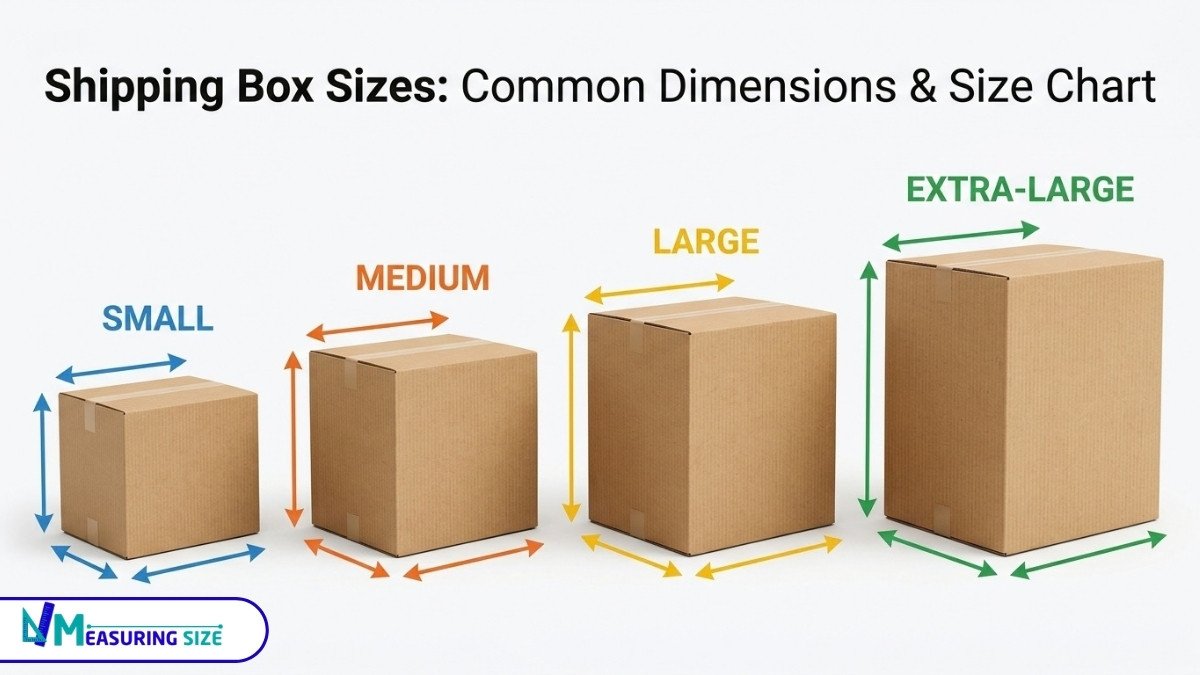
Shipping box sizes vary depending on what you are sending, how much protection it needs, and how much space the package takes up. Common options range from small boxes for compact items to larger boxes for bulky products and multiple items.
Most box dimensions are listed as Length × Width × Height (L × W × H). In this guide, you’ll find common shipping box dimensions, a size chart in inches, and tips for measuring a box and choosing the right size for your item.
What Are the Common Shipping Box Dimensions?
| Common box size | Approximate volume | Typical uses | Important sizing note |
| 6 × 6 × 4 in. | 144 cu. in. | Small parts, hardware, cosmetics, samples | Limited room for cushioning around fragile items |
| 8 × 6 × 4 in. | 192 cu. in. | Accessories, candles, small electronics | Useful for compact products with a low profile |
| 8 × 8 × 8 in. | 512 cu. in. | Mugs, jars, small grouped products | A versatile cube for single-item shipments |
| 10 × 8 × 6 in. | 480 cu. in. | Books, boxed food, beauty products | Works well for many small eCommerce orders |
| 10 × 10 × 10 in. | 1,000 cu. in. | Product bundles, kitchenware, supplies | Cube shape can simplify packing and stacking |
| 12 × 9 × 6 in. | 648 cu. in. | Apparel, documents, subscription products | Low height reduces empty space for flatter goods |
| 12 × 10 × 8 in. | 960 cu. in. | Shoes, small appliances, retail orders | Common general-purpose shipping format |
| 12 × 12 × 12 in. | 1,728 cu. in. | Home goods, grouped products, small equipment | One cubic foot before allowing for wall thickness |
| 14 × 10 × 6 in. | 840 cu. in. | Folded clothing, books, elongated products | Better than a cube when the item is long and shallow |
| 14 × 12 × 10 in. | 1,680 cu. in. | Medium product bundles, office supplies | Allows moderate cushioning on multiple sides |
| 16 × 12 × 8 in. | 1,536 cu. in. | Apparel orders, electronics, household goods | A useful medium rectangular carton |
| 16 × 16 × 16 in. | 4,096 cu. in. | Linens, larger household goods, bulk products | Can become costly when filled with lightweight goods |
| 18 × 18 × 16 in. | 5,184 cu. in. | Kitchenware, toys, grouped inventory | Check dimensional weight before regular use |
| 18 × 18 × 18 in. | 5,832 cu. in. | Moving, storage, bulky retail products | Avoid loading with too many dense or heavy items |
| 24 × 18 × 18 in. | 7,776 cu. in. | Large household goods, equipment, bulk shipments | May need stronger board and reinforced closure |
Small Shipping Box Sizes
Small shipping boxes work well for compact products that do not need much packing space. Common examples include:
- 6 × 6 × 4 inches — suitable for small parts, samples, cosmetics, and other compact items.
- 8 × 6 × 4 inches — useful for accessories, candles, and small electronics.
- 8 × 8 × 8 inches — a versatile cube for mugs, jars, and small grouped products.
- 10 × 8 × 6 inches — suitable for books, beauty products, boxed food, and small online orders.
The right size depends on the item and how much protective packaging it needs. Leave enough internal space for cushioning without creating unnecessary empty space.
Medium Box Sizes
Medium shipping boxes are useful for larger individual products, multiple smaller items, and orders that need additional protective packaging. Common examples include:
- 10 × 10 × 10 inches — suitable for product bundles, kitchenware, and supplies.
- 12 × 9 × 6 inches — useful for apparel, documents, and flatter products.
- 12 × 10 × 8 inches — a practical size for shoes, small appliances, and retail orders.
- 12 × 12 × 12 inches — useful for home goods, grouped products, and small equipment.
- 14 × 12 × 10 inches — provides more room for medium-sized products and cushioning.
- 16 × 12 × 8 inches — suitable for apparel orders, electronics, and household goods.
Choose the dimensions based on the packed item’s size rather than relying on a box labeled simply as “medium.”
Large Shipping Box Sizes
Large shipping boxes are designed for bulky products, multiple items, or shipments that need more protective packaging. Common examples include:
- 16 × 16 × 16 inches — suitable for larger household goods, linens, and bulk products.
- 18 × 18 × 16 inches — useful for grouped inventory, toys, and kitchenware.
- 18 × 18 × 18 inches — suitable for bulky retail products, moving, and storage.
- 24 × 18 × 18 inches — useful for large household goods, equipment, and bulk shipments.
For large packages, check the box strength and the carrier’s size and weight limits. A larger box can also increase dimensional shipping costs, particularly when the contents are relatively light.
Box Size Chart
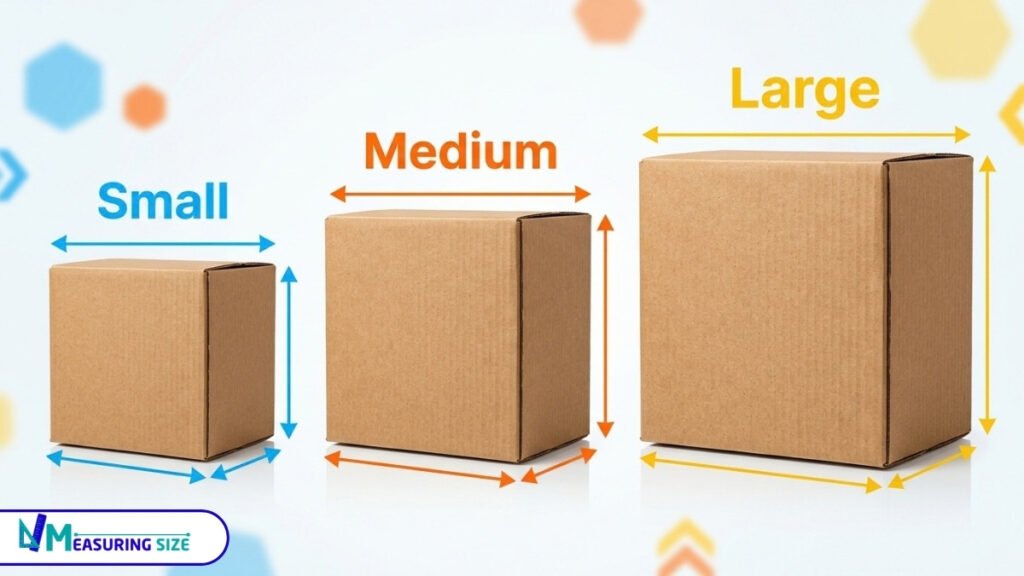
The following chart provides a quick reference for common shipping box dimensions. These sizes are examples, not fixed industry standards.
| Box Size | Dimensions in Inches | Approx. Dimensions in cm | Common Uses |
|---|---|---|---|
| Small | 8 x 6 x 4 | 20.3 x 15.2 x 10.2 | Small electronics, jewelry |
| Medium | 12 x 10 x 8 | 30.5 x 25.4 x 20.3 | Clothing, books |
| Large | 16 x 12 x 10 | 40.6 x 30.5 x 25.4 | Shoes, home goods |
| Extra Large | 24 x 18 x 12 | 61 x 45.7 x 30.5 | Art supplies, toys |
| Flat | 14 x 12 x 2 | 35.6 x 30.5 x 5.1 | Documents, photographs |
There is no single standard shipping box size. Common examples include 8 × 6 × 4, 10 × 8 × 6, 12 × 10 × 8, and 12 × 12 × 12 inches, but availability varies by supplier and intended use.
Shipping Box Dimensions in Inches and cm
Shipping Box Dimensions in Inches
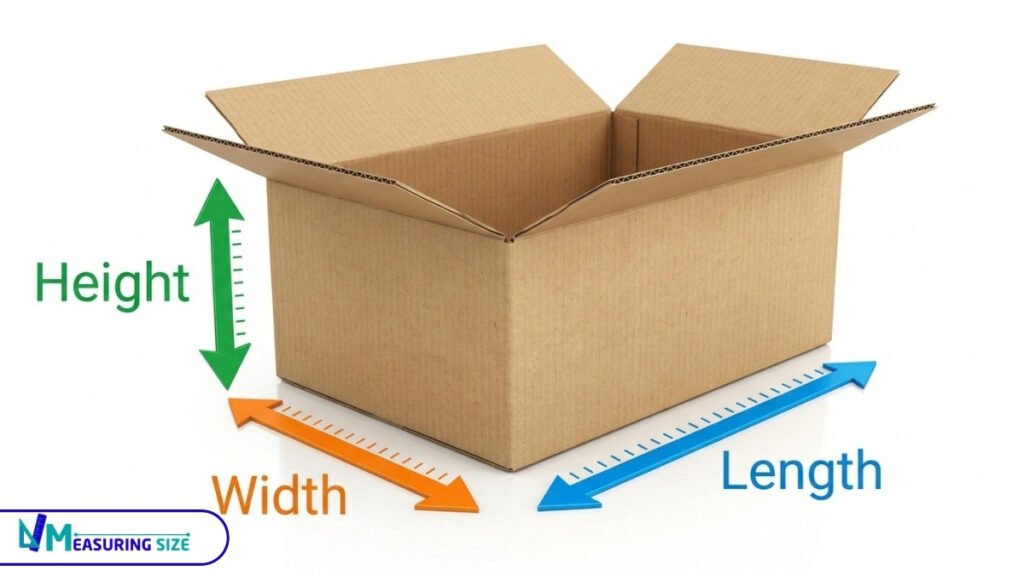
When shipping box dimensions are listed as Length × Width × Height (L × W × H):
- Length: The longest dimension of the box in the usual shipping measurement convention.
- Width: The shorter horizontal dimension.
- Height: The vertical distance from the bottom of the box to the top.
For example, a box measuring 12 × 10 × 8 inches is 12 inches long, 10 inches wide, and 8 inches tall. This precise labeling is crucial for logistics, ensuring that the correct shipping method is chosen and that items fit appropriately within their containers.
Shipping Box Dimensions in cm
When considering shipping box dimensions in cm, it’s essential to convert the measurements accurately from inches to centimetres. The conversion factor is straightforward: 1 inch equals 2.54 cm. Therefore, to find the dimensions in cm, simply multiply each measurement in inches by 2.54.
For example, if your box measures 12 inches in length, 10 inches in width, and 8 inches in height, the conversions would be:
- Length: 12 inches × 2.54 = 30.48 cm
- Width: 10 inches × 2.54 = 25.4 cm
- Height: 8 inches × 2.54 = 20.32 cm
Thus, the shipping box dimensions in cm would be presented as 30.48 cm × 25.4 cm × 20.32 cm. Understanding these conversions is crucial for accurate shipping and storage, ensuring your package fits neatly within logistical systems designed with metric dimensions.
Internal vs. External Shipping Box Dimensions
Shipping boxes can be described using either their internal or external dimensions, and the difference matters when choosing a box.
- Internal dimensions: The usable space inside the box. These are important when checking whether your product and protective packaging will fit.
- External dimensions: The measurements from the outside of the completed package. These can matter when a carrier calculates shipping charges based on package size.
If you are choosing a box for product fit, check its internal dimensions. For shipping measurements, check the carrier’s requirements and measure the completed package when necessary.
How Are Shipping Box Dimensions Measured?
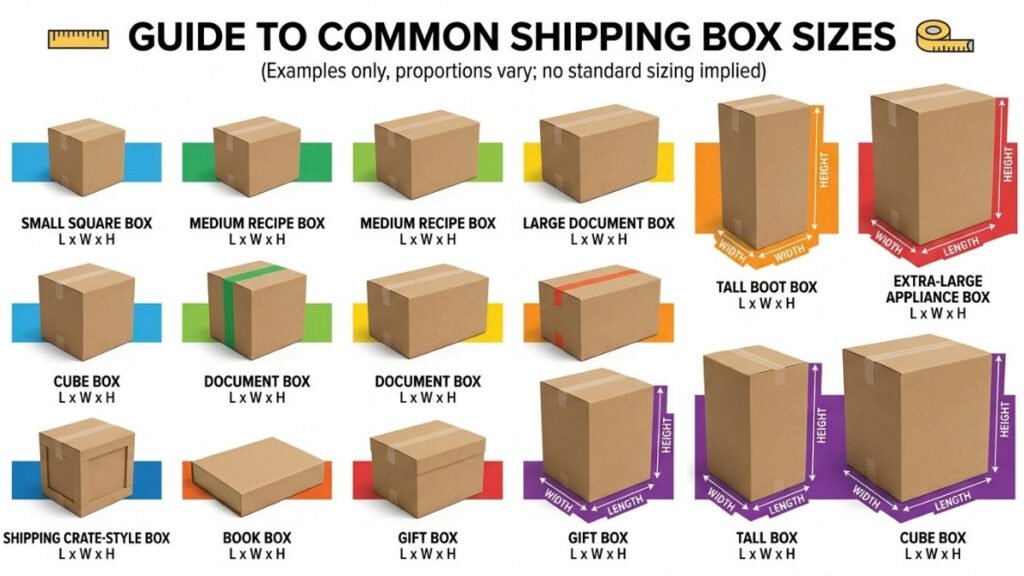
Shipping box dimensions are generally listed as Length × Width × Height. The exact measurement approach depends on whether you are checking the space available inside the box or measuring the completed package for shipping.
Length
When checking a box for product fit, measure the usable internal length. If you are measuring a completed package for a carrier, follow the carrier’s measurement rules and use the package’s external dimensions.
To measure the length accurately, follow these steps:
- Position the Box: Place the box on a flat surface with the open flap facing you.
- Use Measuring Tools: Take a measuring tape or a ruler and align it with one end of the box.
- Measure Across: Extend the measuring tool across to the opposite end of the box’s longest side.
- Record the Measurement: Note the measurement in inches or centimetres for clarity.
Width
Width is the shorter horizontal dimension, measured across the box perpendicular to its length.
For product fit, use the internal width. For carrier measurements, use the external dimensions of the completed package when required.
Height
When measuring the height of a shipping box, you’re looking from the bottom to the top. Start at tHeight is the vertical distance from the bottom of the box to the top.
Measure the usable internal height when determining whether your product and protective packaging will fit. For a completed shipment, follow the carrier’s rules for measuring the package’s external height.
How to Choose the Right Shipping Box Size
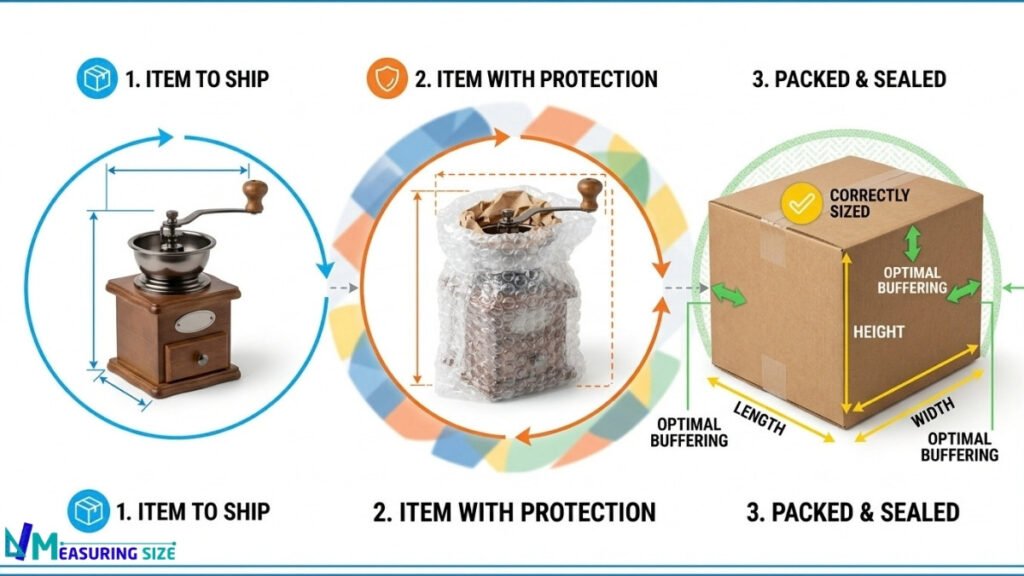
Choosing the right shipping box size is crucial for ensuring your products arrive safely and cost-effectively. Here’s how to make that decision:
- Product dimensions: Measure your item accurately. Length, width, and height are essential to finding a box that fits snugly without being too tight.
- Product shape: Irregularly shaped items may require specialized boxes or additional packing materials to prevent movement. Round or oddly shaped products might benefit from cushioning.
- Protective packaging: Consider how much protection your item needs. Fragile items should be snugly packed with materials like bubble wrap or foam peanuts, which might require a slightly larger box.
- Available internal space: Aim for a box that minimizes empty space while still allowing for protective packaging. Too much empty space can lead to shifting during transit.
- Shipping costs: Larger boxes can increase shipping fees, so selecting a box that fits well can help you save on costs. Always check with your carrier for their specific size guidelines.
By thoughtfully assessing these factors, you can choose shipping box dimensions that ensure your products arrive intact and efficiently.
Measure the Item
Before you choose a shipping box, measuring your product is essential. Accurate measurements ensure that your item fits snugly and safely, minimizing movement during transit. To measure your item, focus on the following dimensions:
- Length: Measure from one end to the other, at the longest point.
- Width: Measure across the widest part of the item.
- Height: Check the tallest point of the product.
For irregularly shaped items, take extra care. These products often have bumps or protrusions that can affect the overall size when packed. A box that suits the item’s basic measurements might still be too tight or too loose when it’s packed. Here are some practical tips for such items:
- Assess overall shape: Look at how the item will fit in a box, considering any excess bulk.
- Consider packaging materials: Decide if additional padding or protective materials will impact the required box dimensions.
By measuring accurately, you can avoid costly shipping mistakes and ensure that your item arrives in perfect condition.
Allow Space for Packaging
When selecting a shipping box, consider how much extra space is needed for protective materials. The right cushioning not only safeguards your items but also ensures they arrive intact.
Here are key points to keep in mind:
- Fragility: Delicate items like ceramics require more padding than sturdy products.
- Shape: Oddly shaped goods might need more cushioning to prevent shifting during transit.
- Protection Type: Different materials — like foam for electronics or bubble wrap for glass — demand specific box sizes.
Balancing box size with adequate internal space can prevent damage. Ultimately, the amount of extra room will depend on your item’s unique needs, so choose wisely!
Avoid Oversized Boxes
When selecting a shipping box, going too large can lead to several inefficiencies:
- Unnecessary Empty Space: Extra room means less stability for your product, paving the way for potential damage during transit.
- More Packing Materials: A larger box often requires additional padding, leading to excess costs and waste.
- Product Movement: Your items can shift around, which increases the risk of breakage or damage.
- Higher Shipping Costs: Carriers often charge based on weight and size, so oversized boxes could mean higher fees.
Instead of simply opting for the smallest box, aim for a practical size that snugly fits your product while allowing for essential protection. This approach ensures your items arrive safely without unnecessary added expenses.
Do Box Sizes Affect Shipping Costs?
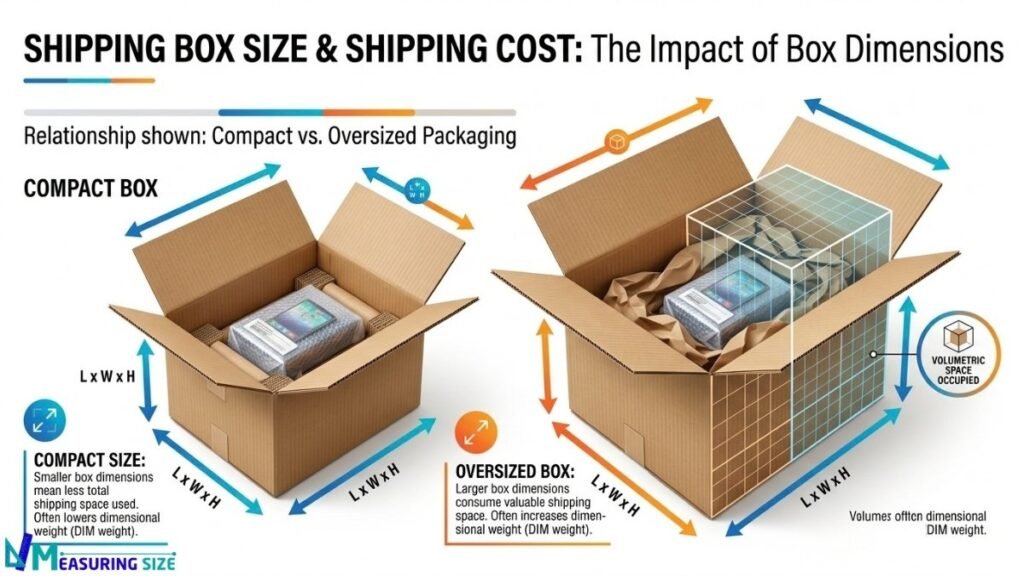
The size of your shipping box can have a significant impact on shipping costs. Many carriers consider both the actual weight and the dimensional (or volumetric) weight when calculating fees.
Oversized packaging can lead to additional charges for a few reasons:
- Space Utilization: Larger boxes use more space, which limits how many packages can fit on a vehicle.
- Fuel Efficiency: Heavier or larger packages can require more fuel to transport.
What Is Dimensional Weight?
Dimensional weight, also called volumetric weight, is a shipping calculation based on the amount of space a package occupies rather than only its actual weight.
A large, lightweight package can therefore be charged based on its dimensional weight if the carrier’s rules apply. The exact calculation and divisor vary by carrier, service, and region, so check the carrier’s current pricing rules before estimating the shipping cost.
Using a box that fits the product and its protective packaging can help reduce unnecessary package volume..
Common Shipping Box Size Mistakes
- Choosing a box that is too small: This often leads to damaged items as they get wedged or crushed. Always ensure your product fits comfortably without excessive force.
- Choosing an unnecessarily large box: Overly spacious boxes can cause the items to shift during transit, increasing the risk of damage. Opt for a size that snugly accommodates your products.
- Measuring only the product and ignoring packaging: Don’t forget that additional packaging materials, like bubble wrap or foam, take up extra space. Measure everything together for a proper fit.
- Confusing internal and external dimensions: Understand the difference between these measurements; the internal size affects how well your product fits, while external dimensions are crucial for shipping costs.
- Ignoring the product’s shape: Irregular items may require custom box designs or additional padding. A box that doesn’t match the shape can lead to vulnerabilities during transport.
- Using insufficient protective space: Skimping on cushion space may save costs but leaves your products at risk.
Conclusion
Shipping box sizes vary depending on the product, protective packaging, and shipping requirements. Common dimensions such as 8 × 6 × 4, 12 × 10 × 8, and 24 × 18 × 18 inches can help you compare options, but there is no single standard size for every shipment.
Measure the item carefully, allow enough space for protection, and choose a box that avoids unnecessary empty space. Remember that box dimensions are generally written as Length × Width × Height.
FAQs
What Are the Most Common Shipping Box Sizes?
There is no single standard shipping box size. Common examples include 8 × 6 × 4, 10 × 8 × 6, 12 × 10 × 8, and 12 × 12 × 12 inches, but availability varies by supplier and intended use.
What Order Are Box Dimensions Written In?
Box dimensions are typically written in the order of length, width, and height. For example, a box listed as 24″x16″x12″ means it’s 24 inches long, 16 inches wide, and 12 inches high.
How Do You Measure a Shipping Box?
To choose a box, check its internal length, width, and height because these determine the usable space inside. When entering dimensions for a shipping carrier, measure the completed package according to that carrier’s instructions, since shipping measurements can use the outer package dimensions.
What Is the Best Box Size for Shipping?
The best box size for shipping depends on your item. Generally, it should fit snugly without too much extra space. This helps protect your item during transport and can save on shipping costs.
How Much Bigger Should a Shipping Box Be Than the Item?
A shipping box should be large enough to hold the item and the protective packaging without forcing the product into the box. The required clearance depends on the item’s size, shape, fragility, and cushioning material. Choose the smallest practical box that provides adequate protection.