
How Much Is 100 Grams? 12 Common Things That Weigh About 100 Grams
One hundred grams is a small amount of weight, but it can be difficult to estimate if you do not use a kitchen scale. Comparing 100 grams with familiar foods and everyday portions makes the measurement easier to understand.
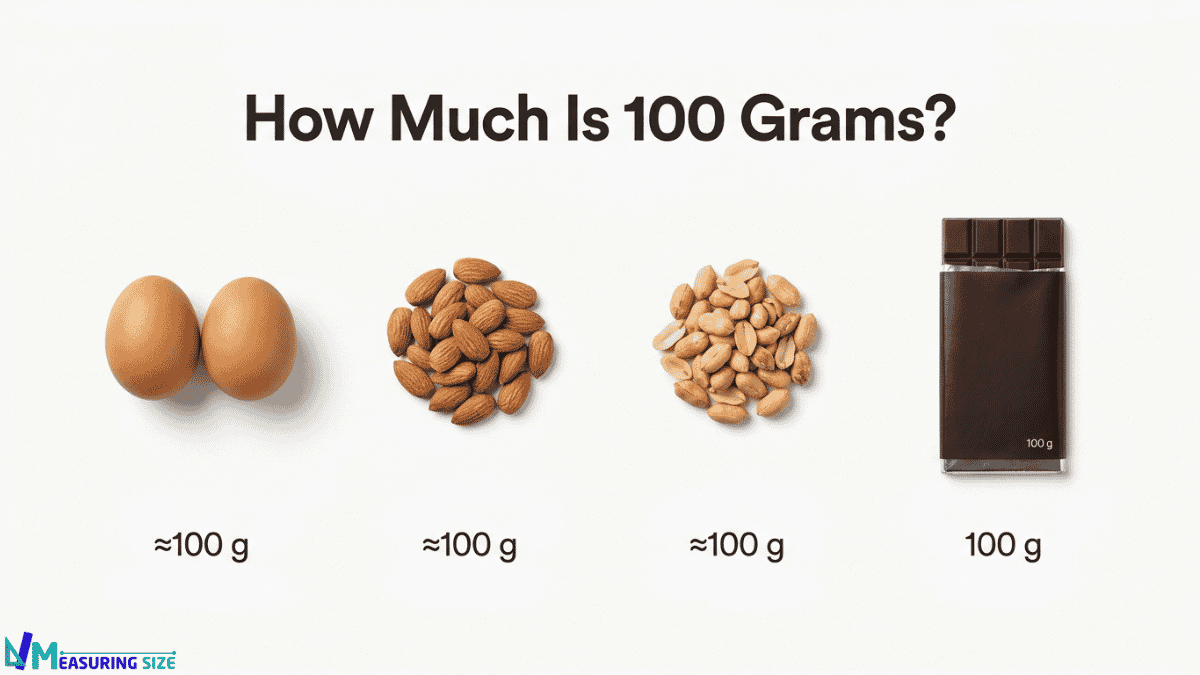
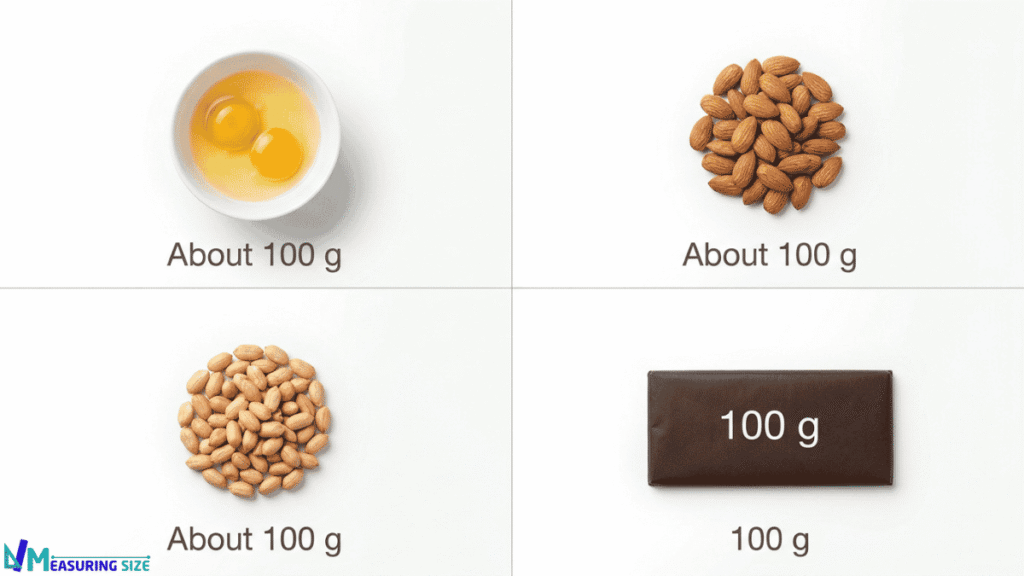
100 grams equals 0.1 kilograms, approximately 3.53 ounces, or 100,000 milligrams. It is close to the weight of two large eggs without their shells, a little over half a cup of whole almonds, or a chocolate bar labeled 100 grams.
In this guide, you will learn how much 100 grams is, see a simple conversion chart, and discover 12 common food comparisons that can help you estimate this weight.
How Much Is 100 Grams?
100 grams is equal to one-tenth of a kilogram or about 3.53 ounces. It is a lightweight measurement commonly used for food portions, ingredients, and small products.
Here are the main conversions:
- 100 grams = 0.1 kilograms
- 100 grams = 100,000 milligrams
- 100 grams ≈ 3.527 ounces
- 100 grams ≈ 0.2205 pounds
For a simple comparison, two large eggs without their shells weigh approximately 100 grams combined. According to USDA food data, one large whole egg without its shell weighs about 50.3 grams, making two eggs approximately 100.6 grams.
100 Grams Conversion Chart
| Unit | Equivalent |
|---|---|
| Grams | 100 g |
| Kilograms | 0.1 kg |
| Milligrams | 100,000 mg |
| Ounces | 3.527 oz |
| Pounds | 0.2205 lb |
These conversions are useful when following recipes, checking nutrition labels, or comparing products that use different measurement units.
12 Common Things That Weigh About 100 Grams

The following foods provide practical comparisons for understanding 100 grams. Their weights are approximate unless a specific package or measured portion is mentioned. Actual weight can vary with food size, variety, brand, and preparation.
1. Two Large Eggs
Two large eggs are one of the easiest ways to estimate 100 grams.
- One large egg without its shell weighs about 50.3 grams.
- Two large eggs without their shells weigh about 100.6 grams.
- The weight can differ slightly depending on egg size.
This is one of the more reliable comparisons because USDA food data provides a standard weight for a large egg. If you need precisely 100 grams for a recipe, weigh the eggs after removing their shells.
2. About Two-Thirds of a Cup of Whole Almonds
Whole almonds are another useful food comparison. USDA-based portion data lists one US cup of whole almonds at approximately 143 grams. That means two-thirds of a cup weighs about 95 grams.
- One cup of whole almonds: about 143 g
- Two-thirds of a cup: about 95 g
- A slightly fuller measure can bring the amount closer to 100 g
The exact amount depends on the size of the almonds and how you fill the measuring cup. For a more accurate portion, use a kitchen scale.
3. About Two-Thirds of a Cup of Peanuts
Peanuts can also help you visualize a 100-gram portion. A USDA-based conversion table lists one cup of peanuts at approximately 146 grams. Two-thirds of a cup is therefore about 97 grams.
- One cup of peanuts: about 146 g
- Two-thirds of a cup: about 97 g
- A small difference in the portion can bring it close to 100 g
This comparison works best with plain peanuts rather than peanuts mixed with shells or other ingredients. Measuring by weight is more accurate than estimating by volume.
4. Half a Cup of Uncooked Rice
Half a cup of uncooked rice is commonly used as a rough comparison for 100 grams. However, the actual weight depends on the rice variety and how the cup is filled.
For a more reliable measurement:
- Check the package for its gram weight per serving.
- Use the serving size to estimate the amount in half a cup.
- Weigh the rice if your recipe requires exactly 100 grams.
Remember that uncooked rice and cooked rice have different weights per cup because cooked rice absorbs water. Make sure you compare the same preparation state.
5. About Four Large Medjool Dates
Four large Medjool dates can weigh around 100 grams, depending on their size and moisture content. This makes them a convenient comparison if you regularly eat dates as a snack.
- Larger dates generally weigh more than smaller dates.
- Dates can vary in moisture and size.
- Removing the pits changes the total weight.
Treat four dates as an estimate rather than an exact measurement. If you need 100 grams for a recipe or serving, weigh the dates after removing the pits if the recipe calls for pitted dates.
Explore How Much Is 10 Grams? 10 Common Things That Weigh 10 Grams
6. About Two Medium Carrots
Two medium carrots can provide a rough visual comparison for 100 grams, although their combined weight varies considerably.
Carrot weight depends on length, thickness, and variety. Two small carrots may weigh less than 100 grams, while two large carrots may weigh more.
For a closer estimate, wash the carrots, trim their ends if needed, and weigh the portion you plan to use. This is especially helpful when preparing soups, salads, or roasted vegetables.
7. Nearly One Cup of Rolled Oats
A cup of rolled oats can weigh close to 100 grams, depending on the product and the measuring method. Some oats are denser than others, and scooping can pack more oats into a cup.
To estimate a 100-gram portion:
- Check the nutrition label for the serving weight.
- Measure the corresponding amount using a dry measuring cup.
- Avoid pressing the oats down into the cup.
If you are baking or tracking food portions, measuring oats in grams is more dependable than relying on cup measurements alone.
8. Three-Quarters of a Cup of All-Purpose Flour
About three-quarters of a cup of all-purpose flour is a commonly cited comparison for 100 grams. However, flour weight can change significantly depending on whether it is sifted, spooned into the cup, or packed down.
For better accuracy:
- Use the gram measurement listed in your recipe.
- If using a measuring cup, fill it lightly rather than packing the flour.
- Level the top with a straight edge.
A kitchen scale is the best option for baking because small differences in flour weight can affect the texture of the finished food.
9. About Five Slices of White Bread
Five slices of commercial white bread can weigh around 100 grams, but this depends on the brand and slice thickness.
Thin sandwich slices usually weigh less than thick-cut slices. Bread made with different ingredients can also have different weights.
Check the package for the serving size and total weight. If the label lists the weight of two slices, for example, you can use that information to estimate how many slices are close to 100 grams.
10. Half a Medium Baked Potato
Half a medium baked potato can be a useful rough comparison for 100 grams, depending on the potato’s original size and how it is prepared.
A larger potato can contain considerably more than 100 grams of edible flesh, while a smaller one may contain less. Cooking also changes the potato’s water content and therefore its weight.
For the most accurate estimate, weigh the cooked portion you plan to eat. If the skin is included, keep it on the scale when measuring the portion.
11. A Small Apple Portion
An apple is a familiar way to picture a 100-gram amount, but a whole medium apple is often heavier than 100 grams. A portion of a medium apple is a better comparison.
For example, half of a medium apple can weigh around 90 grams, depending on the apple’s size. A small apple may also be close to 100 grams, but not every apple will match that weight.
The important point is to compare the weight of the actual apple or portion rather than assume all apples weigh the same.
12. A Chocolate Bar Labeled 100 Grams
A chocolate bar marked 100 g on its packaging is one of the simplest references for this measurement.
Unlike fruit or other foods that naturally vary in size, the stated net weight on a product label gives you a clear target. Keep in mind that the 100-gram figure refers to the chocolate, not necessarily the wrapper or outer packaging.
Check the net weight before using a chocolate bar as a comparison. Some bars are sold in 80-gram, 90-gram, 100-gram, or other sizes.
How Heavy Is 100 Grams in Your Hand?
One hundred grams is light enough to hold comfortably in one hand. It is roughly the weight of two large eggs without their shells or a measured portion of nuts.
The way an object feels also depends on its size and material. A small, dense object may feel heavier than a larger object of the same weight because the weight is concentrated in a smaller area.
For the most dependable comparisons, choose foods with a known portion weight or products with a clearly stated net weight.
How to Measure 100 Grams Without a Scale
You can estimate 100 grams without a scale, but the result may not be exact. Try these methods:
- Check the package: Look for the net weight or serving weight on food packaging.
- Use a standard portion: Compare the food with a serving whose gram weight is documented.
- Use measuring cups carefully: Cups measure volume, not weight, so results vary by ingredient.
- Compare with two large eggs: Two large eggs without their shells weigh about 100.6 grams on average according to USDA food data.
- Use a kitchen scale when accuracy matters: This is the best choice for baking, portion control, and recipes that require a specific weight.
If you are estimating a portion for cooking or nutrition, remember that a visual comparison is only a guide. Weighing the food is more accurate.
Conclusion
One hundred grams equals 0.1 kilograms, 100,000 milligrams, approximately 3.53 ounces, or 0.2205 pounds. Familiar comparisons can make this weight easier to understand, especially when you use measured food portions or products with a clearly stated net weight.
Two large eggs without their shells are a particularly useful comparison because their combined weight is approximately 100 grams. Portions of almonds, peanuts, rice, oats, and other foods can also help, but their weights vary.
For everyday estimating, these comparisons are useful. When a recipe or task requires an exact amount, use a kitchen scale rather than relying on appearance alone.
FAQs
How much is 100 grams in ounces?
100 grams is approximately 3.527 ounces, usually rounded to 3.53 ounces.
How much is 100 grams in kilograms?
100 grams equals 0.1 kilograms. One kilogram contains 1,000 grams.
Can I measure 100 grams without a kitchen scale?
You can estimate it using package labels, documented food portions, or familiar comparisons such as two large eggs. However, measuring cups and visual estimates are not exact substitutes for a scale.
What common food weighs about 100 grams?
Two large eggs without their shells weigh approximately 100.6 grams. Other rough comparisons include around two-thirds of a cup of whole almonds, a measured portion of peanuts, or a chocolate bar labeled 100 grams.

