
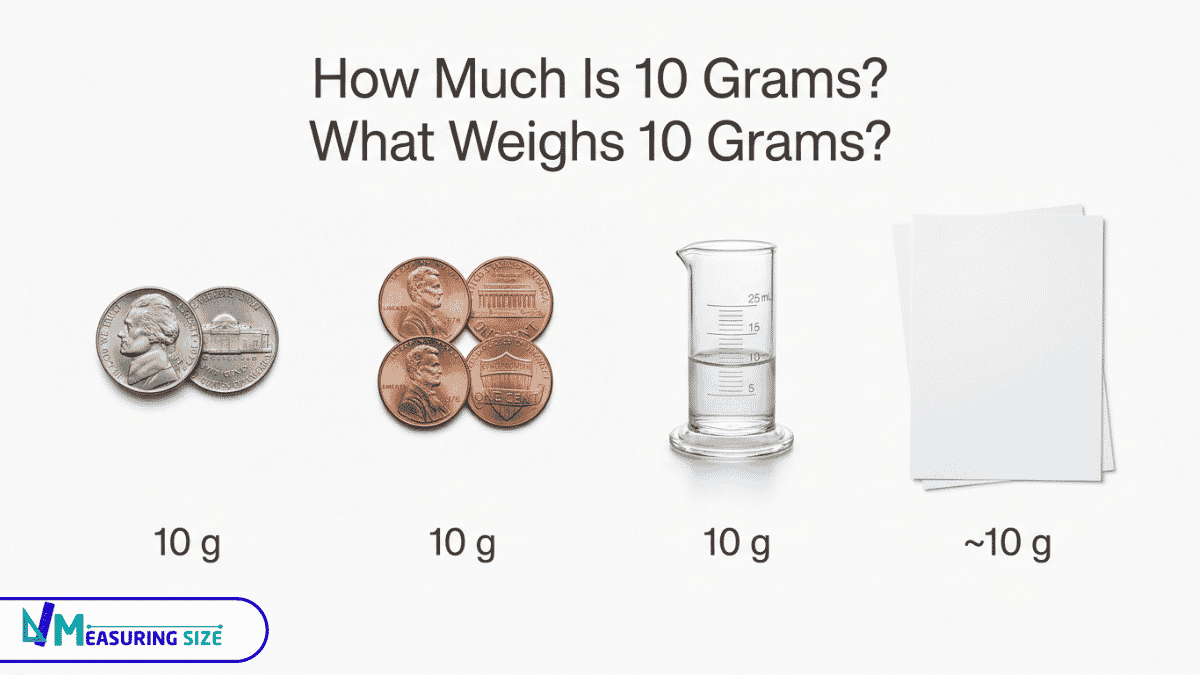
How Much Is 10 Grams? 10 Common Things That Weigh 10 Grams
Ten grams is a small amount of weight, equal to 0.01 kilograms, 10,000 milligrams, or about 0.35 ounces. But what does 10 grams actually look or feel like? Everyday references such as two U.S. nickels, a small amount of water, or a couple of sheets of paper can make this measurement easier to understand. Some examples are exact, while others are only approximate because their weight can vary.
How Much Is 10 Grams?
Ten grams equals 0.01 kilograms, 10,000 milligrams, approximately 0.3527 ounces, and 0.02205 pounds. Grams measure weight or mass, and the actual size of 10 grams can vary depending on what you’re measuring. For instance, 10 grams of sugar looks quite different than 10 grams of feathers due to their varying densities.
Because grams measure mass, the physical amount of space occupied by 10 grams depends on the material. For example, 10 grams of water, sugar, and feathers will take up different amounts of space because each material has a different density.
Key conversions:
- 10 grams = 0.01 kilograms
- 10 grams = 10,000 milligrams
- 10 grams ≈ 0.3527 ounces
- 10 grams ≈ 0.02205 pounds
Understanding these conversions can simplify cooking, measuring, or even just keeping track of your daily intake. Grams are a handy unit for everyday situations!
10 Grams Conversion Chart
| Measurement | Equivalent |
|---|---|
| Milligrams | 10,000 mg |
| Kilograms | 0.01 kg |
| Ounces | 0.3527 oz |
| Pounds | 0.02205 lb |
What Weighs 10 Grams?
When exploring the concept of 10 grams, it’s fascinating to realize that not all weights are created equal. Some items, like standardized weights, give us a precise match, while everyday objects and foods can only approximate that value.
Several factors influence how much something weighs, including:
- Size: A larger item may weigh more than expected.
- Material: Different substances can weigh significantly different amounts.
- Product variation: Even the same type of item can differ from one brand to another.
- Density: Some materials are lighter or heavier for their size.
- Measurement method: How we measure can also impact the weight recorded.
Common Things That Weigh About 10 Grams
| Object / Item | Weight | Accuracy |
|---|---|---|
| Two U.S. nickels | 10 g | Exact |
| Four modern U.S. pennies | 10 g | Exact |
| 10 mL of water | ~10 g | Very close |
| Two sheets of A4 paper, 80 gsm | ~10 g | Very close |
| Two sheets of US Letter paper, 75 gsm | ~9.05 g | Approximate |
| 10 standard paper clips | Variable | Approximate |
| Two U.S. teaspoons of water | ~9.86 g | Very close |
| Two teaspoons of granulated sugar | Variable | Approximate |
| Two teaspoons of table salt | Variable | Approximate |
| About seven almonds | Variable | Approximate |
| About two teaspoons of uncooked rice | Variable | Approximate |
| One small chocolate square | Variable | Product-dependent |
1. Two U.S. Nickels
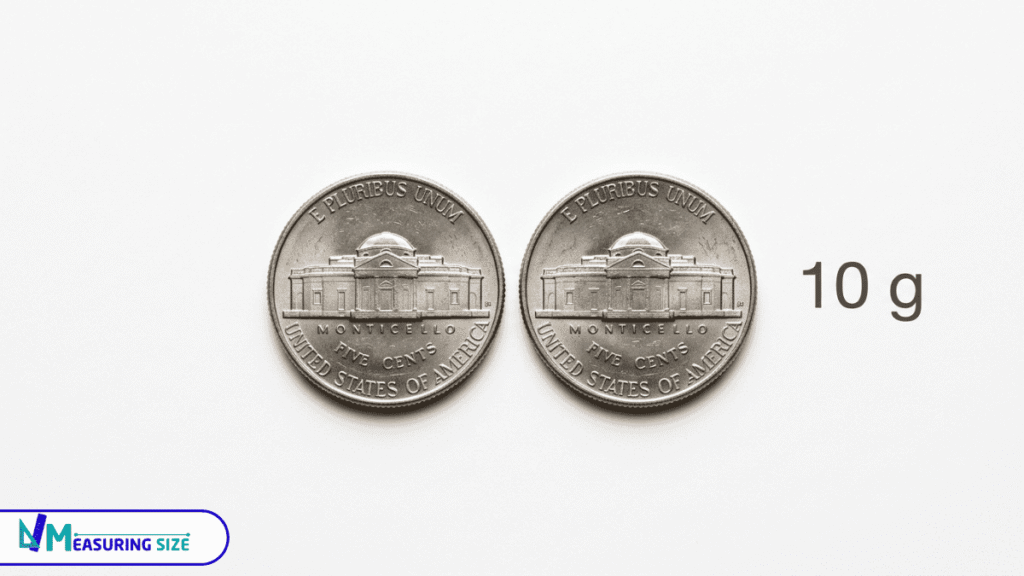
Using two modern U.S. nickels is a straightforward way to visualize 10 grams. Each nickel weighs exactly 5 grams, so when you put two together, you get a total weight of 10 grams. This method is simple and effective.
Key Measurements:
- Single Nickel: 5 grams
- Two Nickels: 10 grams
This is one of the most reliable everyday references because the current U.S. nickel has a standardized weight of 5 grams. Two modern U.S. nickels therefore total exactly 10 grams.
2. Four U.S. Pennies
Here are some quick facts about modern U.S. pennies:
- Weight of one modern U.S. penny: 2.5 grams
- Weight of four modern U.S. pennies: 10 grams
- Composition: Made mostly of zinc with a thin copper coating
- Older pennies: Pre-1982 pennies weigh 3.1 grams due to different material
3. 10 Millilitres of Water
Water is unique because of its density. Under typical conditions, it has a density of about 1 gram per millilitre. This means that:
- 1 millilitre of water weighs about 1 gram.
- Therefore, 10 millilitres of water will weigh approximately 10 grams.
4. Two Sheets of A4 Paper
Two sheets of standard A4 paper at 80 gsm weigh about 10 grams in total. A single sheet weighs approximately 4.99 grams, so two sheets come to about 9.98 grams.
- A4 Sheet Size: 210 × 297 mm
- Area: Approximately 0.0624 square metres
- Weight: One sheet weighs around 5 grams
This means two sheets together come in at roughly 10 grams. It’s a neat example of how paper weight works. But remember, the weight can change if the GSM (grams per square meter) differs.
5. Two Sheets of US Letter Paper
Two sheets of standard US Letter paper can provide a close comparison to 10 grams. Using typical 75 gsm paper, each sheet weighs about 4.52 grams, so two sheets weigh approximately 9.05 grams.
Key measurements:
- Size: 8.5 × 11 inches (215.9 × 279.4 mm)
- Paper weight: 75 gsm
- One sheet: ~4.52 g
- Two sheets: ~9.05 g
The actual weight can vary with the paper’s GSM, moisture, and manufacturing specifications, so this should be treated as an approximate comparison.
6. 10 Standard Paper Clips
Two U.S. teaspoons of water provide a very close comparison to 10 grams. One U.S. teaspoon holds about 4.93 mL, so two teaspoons contain approximately 9.86 mL of water. Because water has a density close to 1 g/mL, this amount weighs about 9.86 grams.
Key measurement:
- 2 U.S. teaspoons of water: ~9.86 g
This comparison applies to water. Other ingredients have different densities, so two teaspoons of another substance will not necessarily weigh the same.
7. Two Teaspoons of Water
Two U.S. teaspoons of water provide a very close comparison to 10 grams. A U.S. teaspoon is about 4.93 mL, so two teaspoons hold approximately 9.86 mL. Because water has a density close to 1 gram per millilitre, this amount weighs about 9.86 grams.
Key measurement:
- 2 U.S. teaspoons of water = about 9.86 mL
- Weight = about 9.86 grams
This is a useful everyday estimate, but it is not an exact 10-gram measurement. For precise weighing, use a digital scale.
8. Two Teaspoons of Granulated Sugar
Two teaspoons of granulated sugar can be used only as a rough visual comparison for a small weight. The exact mass depends on the amount of sugar in each spoon and how the sugar is measured, so it should not be presented as an exact 10-gram measurement.
For accurate cooking or baking, weighing the sugar with a kitchen scale is more reliable than converting teaspoons to grams.
9. About Seven Almonds
A small handful of almonds can help you visualize what a 10-gram amount looks like, but the exact number of almonds needed will vary. Almonds differ in size, shape, and weight, so seven almonds should be treated only as a rough comparison rather than an exact 10-gram measurement.
If you need exactly 10 grams of almonds for a recipe or portion, a kitchen scale is the better option.
10. About Two Teaspoons of Uncooked Rice
Using about two teaspoons of uncooked rice can give you a rough visual idea of what 10 grams looks like. However, keep in mind that this is not an exact measurement. The weight can change based on several factors, including:
- Rice variety: Different types like basmati or jasmine have unique weights.
- Grain size: Some grains are smaller or larger, affecting how much fits in the spoon.
- Packing: If the rice is tightly packed or loosely filled, the weight will differ.
This demonstrates why the same volume of different ingredients can have varying weights. For example, two teaspoons of rice will not weigh the same as two teaspoons of sugar or salt.
Exact vs Approximate 10-Gram Comparisons
Objects That Can Equal 10 Grams Exactly
Some objects provide a much more reliable 10-gram reference than others because their weight is standardized.
Two modern U.S. nickels are one clear example. The U.S. Mint lists the weight of a nickel as exactly 5.00 grams, so two nickels total 10.00 grams. Four modern U.S. pennies also total 10.00 grams because each weighs 2.50 grams.
A 10-gram calibration weight is another direct reference because it is specifically manufactured to represent a known mass.
Other examples in this article, such as water, paper, almonds, and chocolate, should be treated as approximate because their weight can vary.
Objects That Weigh About 10 Grams
Many everyday items can help you understand what 10 grams feels like, but they should not all be treated as exact 10-gram references.
Paper, food, and other manufactured items can vary because of their size, material, density, brand, and manufacturing process. For example, two sheets of A4 paper made from 80 gsm stock come very close to 10 grams, while two teaspoons of water are about 9.86 grams.
These examples are useful for visualizing a small amount of weight, but they are not a substitute for a scale when an exact 10-gram measurement is required.
What Does 10 Grams Feel Like?
Ten grams is a very light amount of weight. It is about 0.35 ounces, so it feels much lighter than everyday objects such as a smartphone, book, or typical household container.
For a more reliable reference, two modern U.S. nickels together weigh exactly 10 grams. This gives you a simple physical reference without relying on objects whose weight can vary widely.
Can You Measure 10 Grams Without a Scale?
Use Standardized Objects
Estimating 10 grams can be surprisingly straightforward Standardized objects are more reliable than random household items because their specified weights are well documented.
Two modern U.S. nickels provide a particularly simple reference because each weighs 5 grams, giving a total of 10 grams. Four modern U.S. pennies provide another standardized reference at 2.50 grams each. using standardized objects like
Use Measured Food Portions
When you don’t have a scale, water can provide a useful approximate reference. About 10 mL of water weighs approximately 10 grams.
For a practical kitchen measurement, two U.S. teaspoons hold about 9.86 mL, which corresponds to approximately 9.86 grams of water. A U.S. tablespoon is larger, so it should not be treated as a 10 mL measure.
Remember that teaspoons and tablespoons measure volume, while grams measure mass. Other ingredients can have very different weights for the same volume because their densities differ.
When You Should Use a Digital Scale
A digital scale is the better choice whenever the exact weight matters. This is especially useful for cooking and baking, shipping, jewelry, crafts, experiments, or any task where a small difference can affect the result.
Household comparisons are useful for understanding what 10 grams feels like, but they should not replace a scale when precision is important.
Explore How Long Is 10 Inches? 15 Common Items That Are About 10 Inches
How Much Is 10 Grams in Teaspoons or Tablespoons?
There is no single teaspoon-to-gram or tablespoon-to-gram conversion for every ingredient. Teaspoons and tablespoons measure volume, while grams measure mass, so the conversion depends on the density of the substance.
For water, the relationship is very close to 1 gram per milliliter. One U.S. teaspoon is about 4.93 mL, so 10 grams of water is approximately 10 mL, or about 2.03 U.S. teaspoons. A U.S. tablespoon is about 14.79 mL, so 10 grams of water is roughly 0.68 tablespoon.
For ingredients such as sugar, salt, flour, rice, or chocolate, the amount that weighs 10 grams will be different because each ingredient has a different density. That is why you should not assume that 10 grams always equals two teaspoons or a specific fraction of a tablespoon.
If an exact 10-gram measurement is important, especially for baking or portioning ingredients, a digital kitchen scale is the most reliable option.
10 Grams Compared With Other Common Weights
| Weight | Compared with 10 g |
|---|---|
| 5 g | Half of 10 g |
| 10 g | Reference |
| 20 g | 2× heavier |
| 50 g | 5× heavier |
| 100 g | 10× heavier |
Final Thoughts
Ten grams is a small amount of weight equal to 0.01 kg, 10,000 mg, and about 0.35 oz. Two modern U.S. nickels provide one of the simplest exact 10-gram references, while paper, water, and food can provide useful approximate comparisons. When an exact measurement matters, a digital scale is the most reliable option.
FAQs
How much is 10 grams in ounces?
10 grams is approximately 0.3527 ounces, or about 0.35 oz. This means 10 grams is a little over one-third of an ounce.
What weighs exactly 10 grams?
Two modern U.S. nickels weigh 10 grams in total, because each nickel has a standardized weight of 5 grams. Four modern U.S. pennies also total 10 grams, with each penny weighing 2.5 grams. These are useful exact everyday references.
How can I measure 10 grams without a scale?
You can use a standardized reference such as two modern U.S. nickels to visualize 10 grams. For water, about 10 mL weighs close to 10 grams. These methods are useful for estimation, but a digital scale is the best option when an exact measurement is important.

