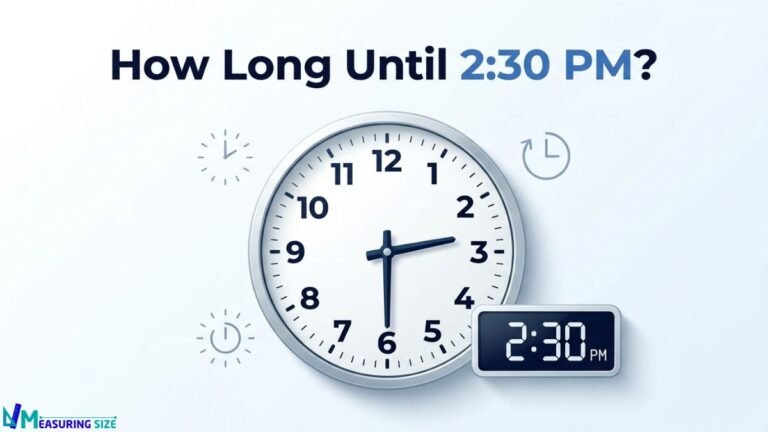

How Long Until 2 PM? Live Countdown, Time Zones, and Manual Calculation Explained
The time left until 2 PM depends on what time it is where you are right now. If it’s 11 AM, you have 3 hours to go. If it’s 1:30 PM, you have 30 minutes. This guide gives you a quick lookup table, two simple ways to work out how long until 2 PM yourself, and a clear explanation of what happens after 2 PM has passed. It also covers time zones, since they cause most of the confusion.
Table of Contents
ToggleLive Countdown to 2 PM
A countdown to 2 PM shows exactly how much time is left until the clock reaches 2:00 in the afternoon. A proper live countdown shows three numbers:
- Remaining hours
- Remaining minutes
- Remaining seconds
The display updates by itself as time passes, so you never have to refresh the page or do any math.
A working countdown can show the remaining hours, minutes, and seconds automatically. Until the timer is available on this page, the table below provides a quick way to check how much time remains until 2 PM.
How Much Time Is Left Until 2 PM Today?
Find your current time in the first column and read across for the time remaining.
| Current Time | Time Remaining Until 2 PM |
|---|---|
| 8:00 AM | 6 hours |
| 9:00 AM | 5 hours |
| 10:00 AM | 4 hours |
| 10:30 AM | 3 hours 30 minutes |
| 11:00 AM | 3 hours |
| 11:30 AM | 2 hours 30 minutes |
| 12:00 PM (noon) | 2 hours |
| 12:30 PM | 1 hour 30 minutes |
| 1:00 PM | 1 hour |
| 1:15 PM | 45 minutes |
| 1:30 PM | 30 minutes |
| 1:45 PM | 15 minutes |
| 1:50 PM | 10 minutes |
| 1:55 PM | 5 minutes |
| 2:00 PM | 0 minutes |
These examples assume you are in one time zone and counting down to today’s upcoming 2 PM. If your clock already shows a time after 2 PM, jump to the section on what happens once 2 PM has passed.
How to Calculate the Time Until 2 PM Manually
You don’t need a calculator for this. Here are two easy methods.
Method 1: Count Forward
Start at the current time and count up to 2 PM. First move to the next full hour, then count the remaining hours.
Example 1: 10:35 AM
- 10:35 to 11:00 is 25 minutes.
- 11:00 to 2:00 is 3 hours.
- Total: 3 hours 25 minutes.
Example 2: 11:20 AM
- 11:20 to 12:00 is 40 minutes.
- 12:00 to 2:00 is 2 hours.
- Total: 2 hours 40 minutes.
Example 3: 12:45 PM
- 12:45 to 1:00 is 15 minutes.
- 1:00 to 2:00 is 1 hour.
- Total: 1 hour 15 minutes.
Example 4: 1:15 PM
- 1:15 to 2:00 is 45 minutes.
Example 5: 1:50 PM
- 1:50 to 2:00 is 10 minutes.
The same method works for any target time. For instance, you can check how much time remains until 3:30 PM using the exact same steps.
Method 2: Subtract Using the 24-Hour Clock
In 24-hour format, 2 PM is written as 14:00. You can subtract your current time from 14:00.
To convert a PM time to the 24-hour format, add 12 to the hour, except for 12 PM, which stays 12:00. For example, 1:15 PM becomes 13:15, while 12:45 PM becomes 12:45. Morning times stay the same, except 12 AM becomes 00:00.
Example 1: 10:35 AM (10:35)
- 14:00 − 10:35
- You can’t take 35 minutes from 0, so borrow an hour. Change 14:00 to 13:60.
- 13:60 − 10:35 = 3 hours 25 minutes.
Example 2: 11:20 AM (11:20)
- 14:00 becomes 13:60.
- 13:60 − 11:20 = 2 hours 40 minutes.
Example 3: 13:15 (1:15 PM)
- 14:00 becomes 13:60.
- 13:60 − 13:15 = 0 hours 45 minutes.
Borrowing just means taking one hour from the hours column and adding it to the minutes column as 60 minutes. You only need to do this when your current time has minutes other than zero.
How Many Hours and Minutes Are Left Until 2 PM?
The same remaining time can be written in hours and minutes, total minutes, or decimal hours. Which one you need depends on what you’re doing. Hours and minutes work for everyday planning. Total minutes work for setting a phone timer. Decimal hours are useful for timesheets and billing.
Some common conversions:
- 1 hour = 60 minutes
- 2 hours = 120 minutes
- 1 hour 30 minutes = 90 minutes = 1.5 hours
- 45 minutes = 0.75 hours
- 30 minutes = 0.5 hours
- 15 minutes = 0.25 hours
The two formulas are simple:
Total minutes = remaining hours × 60 + remaining minutes
Decimal hours = total minutes ÷ 60
| Time Remaining | Total Minutes | Decimal Hours |
|---|---|---|
| 3 hours 25 minutes | 205 | About 3.42 |
| 2 hours 40 minutes | 160 | About 2.67 |
| 1 hour 15 minutes | 75 | 1.25 |
| 45 minutes | 45 | 0.75 |
For example, 3 hours 25 minutes is 3 × 60 + 25 = 205 minutes. Dividing 205 by 60 gives about 3.42 hours.
What Happens If 2 PM Has Already Passed?
If the clock shows 2:30 PM, today’s 2 PM has already passed. In this situation, you may want to know how long remains until tomorrow’s 2 PM.
To find it, count the time left until midnight, then add the 14 hours from midnight to 2 PM. Or use these ready-made examples:
| Current Time (Today) | Time Until 2 PM Tomorrow |
|---|---|
| 2:30 PM | 23 hours 30 minutes |
| 3:00 PM | 23 hours |
| 6:00 PM | 20 hours |
| 10:00 PM | 16 hours |
Here is how the last one works. From 10 PM to midnight is 2 hours, and from midnight to 2 PM is 14 hours. That adds up to 16 hours.
So there are two different questions. “How long until today’s 2 PM?” only makes sense before 2 PM. “How long until the next 2 PM?” always has an answer, and it switches to tomorrow once today’s 2 PM has passed.
What Is 2 PM in 24-Hour Time?
2 PM is 14:00 in 24-hour time. 2 AM is 02:00.
AM stands for the hours from midnight to just before noon. PM covers noon to just before midnight. In this system, 12 AM is midnight and 12 PM is noon.
The 24-hour clock simply numbers the hours from 0 to 23 instead of repeating 1 to 12 twice. You’ll see it in train and flight schedules, military time, hospital records, and most digital systems. To convert a PM time, add 12 to the hour (except 12 PM, which stays 12:00).
Understanding Time Zones for 2 PM
Time zones create two different situations, and mixing them up is the most common mistake.
Situation 1: 2 PM in Your Own Local Time
If you just want to know when it’s 2 PM where you are, only your own clock matters. Everyone reaches their own local 2 PM at a different real-world moment. Someone in Pakistan, someone in the United States, and someone in the United Kingdom will each hit 2 PM hours apart. Your countdown only needs your current local time.
Situation 2: An Event Scheduled for 2 PM in a Specific Time Zone
A meeting, livestream, or appointment set for “2 PM Eastern” happens at one exact moment. People elsewhere must convert that time to their own. Your local 2 PM is irrelevant here.
Here is a typical conversion table for US time zones:
| If the event is at 2 PM in | Eastern Time | Central Time | Mountain Time | Pacific Time |
|---|---|---|---|---|
| Eastern Time | 2 PM | 1 PM | 12 PM | 11 AM |
| Central Time | 3 PM | 2 PM | 1 PM | 12 PM |
| Mountain Time | 4 PM | 3 PM | 2 PM | 1 PM |
| Pacific Time | 5 PM | 4 PM | 3 PM | 2 PM |
These are the usual conversions when the zones keep their normal one-hour gaps. The actual result depends on the event date and daylight-saving rules. Some US locations, including Hawaii and most of Arizona, don’t follow the same daylight-saving schedule as many other states.
Also, don’t assume every event at “2 PM” means Eastern Time. Always check the time zone the organizer states.
How to Convert 2 PM Eastern Time to Pacific Time
When the usual three-hour difference between Eastern Time and Pacific Time applies, Pacific Time is three hours behind Eastern Time. For example:
- 2 PM Eastern = 11 AM Pacific
- 3 PM Eastern = 12 PM Pacific
- 4 PM Eastern = 1 PM Pacific
One caution: EST and EDT are not the same thing. EST (Eastern Standard Time) is used in winter, and EDT (Eastern Daylight Time) is used during daylight-saving months. People often write “EST” all year, but the correct label depends on the date. If a schedule says “Eastern Time” or “ET,” that covers whichever one applies.
Why Can Two People See Different 2 PM Countdowns?
If you and a friend see different numbers, one of these is usually the reason:
- You are in different time zones. Each local 2 PM arrives at a different moment.
- One countdown uses local time, the other uses an event time. One may count to your 2 PM, while the other counts to 2 PM in a specific city.
- Device clocks or time-zone settings differ. A wrong setting on a phone or computer shifts the result.
- Daylight-saving time changes the conversion. The gap between two places can shift by an hour at certain times of year.
- One timer is fixed to a time zone. Another may follow each visitor’s own clock.
Checking these settings can help explain why the countdowns differ.
How Does a Live 2 PM Countdown Work?
A real countdown follows a few simple steps:
- It checks the current time.
- It picks 2 PM as the target.
- It subtracts the current time from the target.
- It shows the remaining hours, minutes, and seconds.
- It refreshes the display every second.
- If 2 PM has passed, it switches to the next 2 PM (tomorrow), if that is how the timer is meant to behave.
When a countdown is set to local 2 PM, it relies on the visitor’s device time zone. Two people on the same page can therefore see different results. That is correct behavior for a local countdown. A countdown tied to a fixed event time zone would show everyone the same remaining time.
Conclusion
The time left until 2 PM depends on your current local time and time zone. For quick answers, use the table above. For anything else, count forward to the next hour or subtract from 14:00. If 2 PM has already passed, calculate the time until tomorrow’s 2 PM instead. For scheduled events, always check which time zone the organizer is using before you convert.
Frequently Asked Questions
How many hours are left until 2 PM?
It depends on your current time. Convert 2 PM to 14:00, then subtract your current time in the 24-hour format. Remember to account for the minutes as well. For example, from 9:30 AM to 2 PM is 4 hours 30 minutes. If 2 PM has already passed, calculate the time until tomorrow's 2 PM.
How many minutes until 2 PM?
Work out the hours and minutes left, then multiply the hours by 60 and add the minutes. At 12:30 PM you have 1 hour 30 minutes left, which is 90 minutes.
How long until 2 PM if it is 1:30 PM?
There are 30 minutes left. From 1:30 PM to 2:00 PM is exactly half an hour, or 0.5 hours.
How do I calculate the time until 2 PM without a calculator?
Count forward to the next full hour, then add the remaining whole hours until 2:00. For example, from 11:20, go 40 minutes to noon, then 2 hours to 2 PM. The answer is 2 hours 40 minutes.